
 How Russia's invasion of Ukraine reshaped Black Sea shipping and ports" loading="eager">
When Russia invaded Ukraine in February 2022, it did more than start a land war. It closed one of the world's most important grain and steel export corridors overnight, scattered sea mines across the north-western Black Sea, and turned merchant ships into targets of a state military for the first time in a generation. For any operator with cargo, tonnage or crew exposed to the region, the invasion was a step-change: the kind of conventional state-on-state risk that decades of asymmetric threat planning had not prepared the industry to price.
This article sets out what happened to commercial shipping and ports in the Black Sea, why it still matters for voyage planning today, and what the conflict revealed about how quickly a benign trade lane can become a war zone.
A peaceful trade lane became a front line
Before 2022, the Black Sea was a busy but routine theatre. Ukrainian ports such as Odesa, Chornomorsk and Pivdennyi (formerly Yuzhny) handled the bulk of the country's grain, sunflower oil and steel exports, while Russian terminals at Novorossiysk and Taganrog moved crude, refined products and agricultural commodities. Operators traded there, in the words of the original Dryad Global assessment, "with relatively little cause for concern".
That changed within hours of the invasion. Ukraine's ports were blockaded by the Russian navy and effectively closed to commercial traffic. Dozens of foreign-flagged merchant vessels were trapped in Ukrainian harbours, unable to sail because of the blockade, the risk of fire from both sides, and the laying of sea mines in approach channels. Several ships were struck by missiles, shellfire or mines in the opening weeks, and at least one seafarer was killed aboard a bulk carrier at anchor. The lesson was immediate: in a conventional conflict, civilian shipping enjoys no reliable protection.
Why the disruption mattered beyond the Black Sea
The Black Sea is not a regional sideshow. Ukraine and Russia together account for a substantial share of the world's traded wheat, maize, barley and sunflower oil, and Russia is a leading exporter of crude oil, refined products and fertiliser. Closing Ukrainian ports removed millions of tonnes of grain from the market at a stroke, driving global food prices sharply higher and threatening import-dependent countries across North Africa, the Middle East and South Asia.
The knock-on effects reached every desk in the shipping value chain:
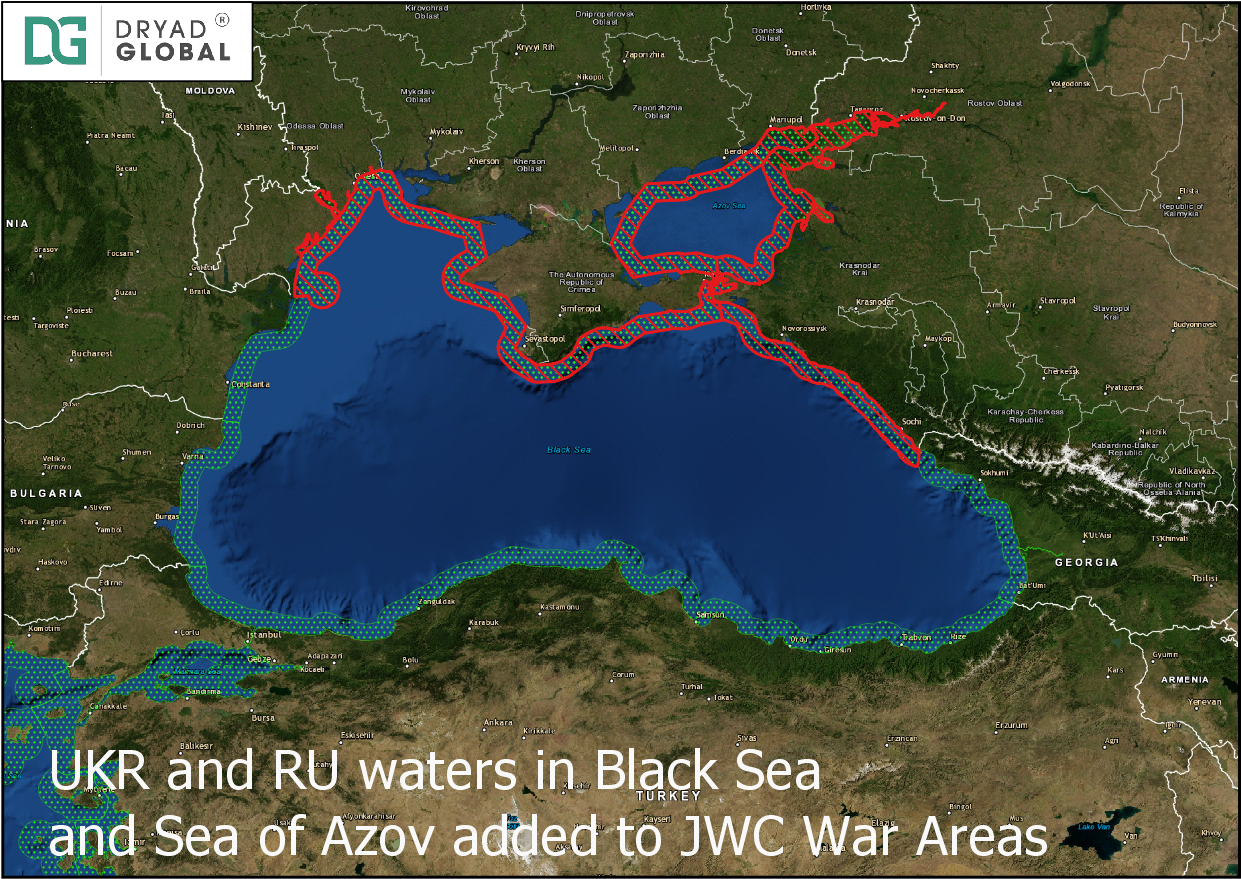
- War risk insurance: underwriters designated the north-western Black Sea and Sea of Azov as listed areas, sending additional war risk premiums from a token figure to a meaningful percentage of hull value per voyage.
- Crew and flag exposure: seafarers trapped on blockaded ships faced months without relief, raising acute welfare, contractual and abandonment concerns.
- Rerouting and tonnage: grain and steel that once moved by sea was forced onto rail, road and Danube river barges, slower and lower-capacity routes that could not absorb the lost volume.
- Sanctions complexity: a fast-moving sanctions regime against Russian cargoes, owners and insurers made compliance, not just safety, a primary voyage-planning constraint.
The grain corridor and its collapse
In July 2022 the Black Sea Grain Initiative, brokered by the United Nations and Turkey, created a protected maritime corridor allowing inspected vessels to load Ukrainian grain at Odesa, Chornomorsk and Pivdennyi and sail to the Bosphorus. Over the following year the corridor moved tens of millions of tonnes of foodstuffs and helped ease the price spike. It was a rare instance of a negotiated safe passage holding in an active war.
Russia withdrew from the agreement in July 2023 and declared that vessels bound for Ukrainian ports could be treated as potential military targets. Ukraine responded with its own unilateral corridor hugging the western Black Sea coast, defended by long-range strike and increasingly capable naval drones. Ports and port infrastructure, including grain silos at Odesa and on the Danube, came under repeated missile and drone attack. The corridor reopened to meaningful traffic, but on terms that left every transit a calculated risk rather than a routine passage.
What it means for operators
The Ukrainian war reset the baseline for maritime risk thinking. Several principles now apply to any operator with Black Sea exposure, and to anyone judging how a conventional conflict could reshape another trade lane:
- State conflict removes the usual mitigations. Convoy, hardening and citadel drills are built for piracy and small-boat attack. They offer little against anti-ship missiles, sea mines and naval drones, which is a fundamentally different threat set.
- Sea mines outlast the headlines. Drifting and moored mines remain a hazard across the north-western Black Sea long after any given strike, and clearance is slow. Mine risk is a persistent voyage-planning input, not a one-off event.
- Insurance and sanctions move as fast as the military picture. War risk listings, premiums and sanctions designations can change within days, so commercial viability has to be reassessed continuously, not at fixture and forgotten.
- Information overload is itself a risk. The conflict produced what Dryad Global described as a "considerable and at times overwhelming deluge of information". Separating verified fact from claim and counter-claim became as important as the underlying threat.
That last point is the enduring lesson. In a contested information environment, the operator who can act on accurate, timely and concise intelligence holds a decisive advantage over one drowning in unverified social-media reporting and competing official narratives.
Where Verihelm helps
Verihelm is the platform Dryad Global built to turn exactly this kind of chaotic, fast-moving picture into intelligence an operator can act on. It ingests incident reporting, naval activity, mine warnings, strike data and sanctions developments from across the Black Sea, then has experienced maritime analysts verify, contextualise and grade each item before it reaches a decision-maker. The result is a single trusted view of a contested theatre: threat levels, affected ports and approaches, and a clear so-what for the voyage in front of you, rather than a raw feed to triage under pressure.
The Ukrainian conflict showed how quickly a routine trade lane can become a war zone, and how much depends on knowing what is real. To see how Verihelm tracks evolving threats across high-risk waters, explore our regional and threat intelligence capability.