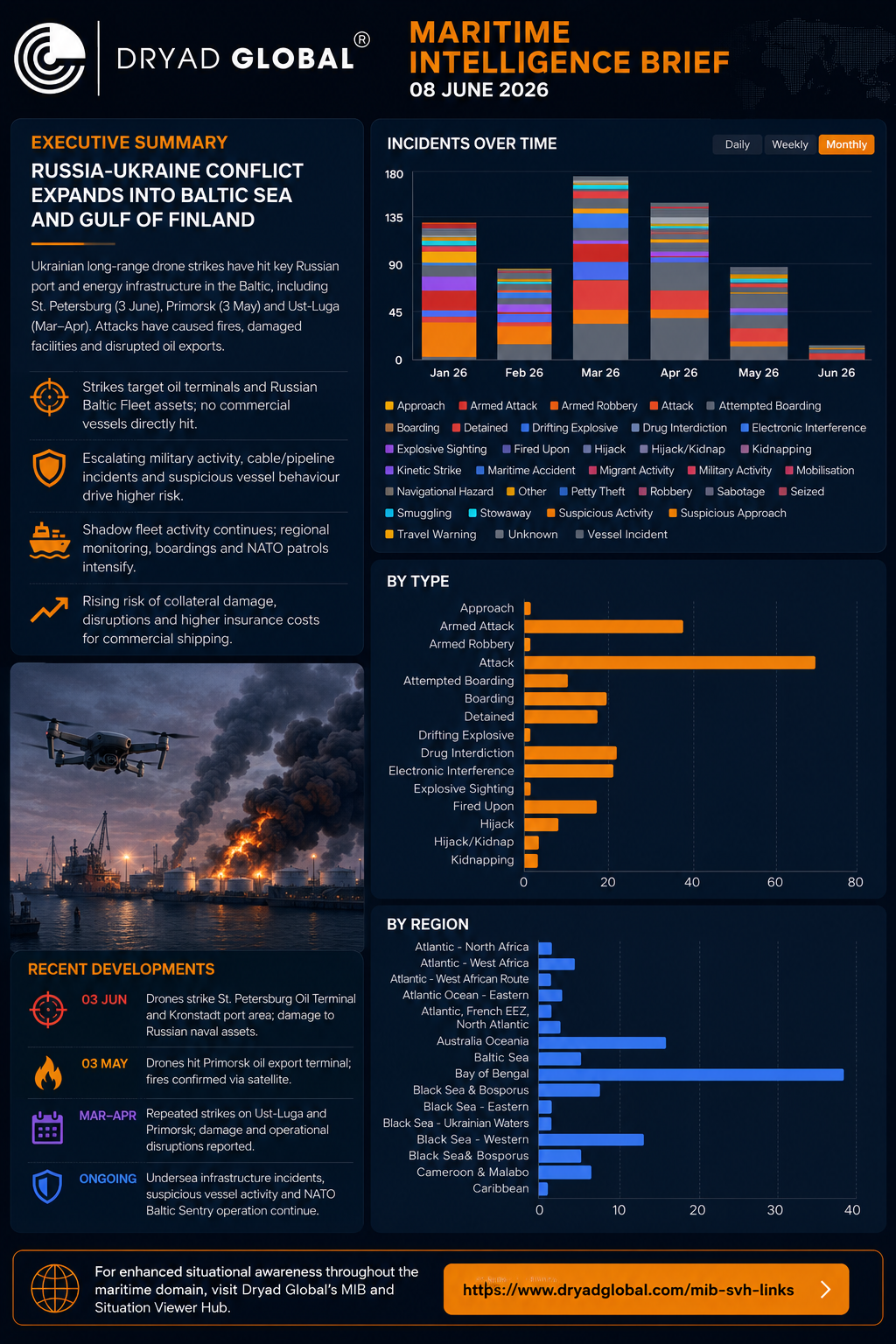
As of early June 2026, the Russia-Ukraine conflict is no longer confined to the Black Sea theatre. Reported long-range Ukrainian drone strikes on Russian port, energy and naval infrastructure around St. Petersburg, Kronstadt, Primorsk and Ust-Luga point to a widening maritime risk picture across the Baltic Sea and Gulf of Finland.
For commercial shipping, the immediate concern is not direct targeting of neutral vessels. The greater risk lies in proximity: energy terminals, military assets and critical infrastructure sit close to key maritime routes. As military activity increases, operators face a more complex operating environment shaped by potential collateral damage, temporary restrictions, debris or spill hazards, electronic disruption, suspicious vessel activity and rising insurance exposure.
The latest Maritime Intelligence Brief examines how recent strikes fit into a broader pattern of activity across European-adjacent waters, including the role of Russia’s shadow fleet, NATO monitoring, Baltic Sentry, undersea infrastructure security and the potential second- and third-order effects for energy markets and global trade flows.
While the incidents are regional, the implications are not. Disruption to Russian Baltic export infrastructure has the potential to affect refined petroleum flows, long-haul shipping patterns, war-risk premiums and supply chain resilience well beyond Northern Europe.
Read the full analysis in this week’s Dryad Global Maritime Intelligence Brief.
Subscribe now: https://www.dryadglobal.com/mib-svh-links