
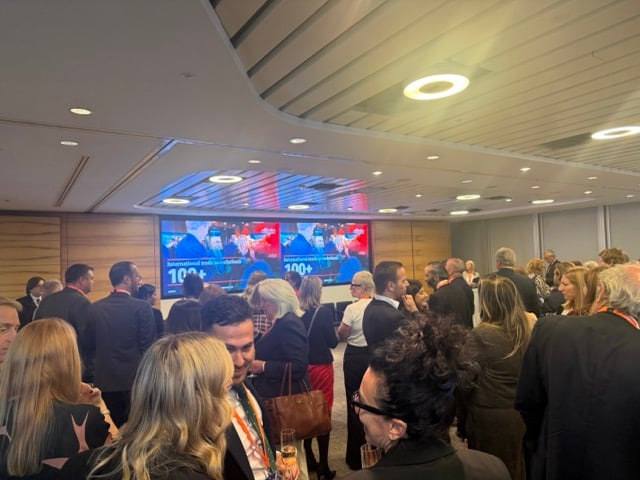
Dryad Global, LISW27 Intelligence and Cyber Risk SponsorS attended the official launch reception for London International Shipping Week 2027 in London.
The event took place at Norton Rose Fulbright on Thursday 17 September, bringing together leaders from across government, shipping, law, technology and maritime services. It marks the beginning of the journey towards LISW27 with its headline conference to be held at the International Maritime Organization in September 2027.
Dryad Global is proud to support LISW27 as its Intelligence and Cyber Risk Sponsor. The partnership reflects a shared commitment to helping the maritime community understand, anticipate and manage an increasingly interconnected risk environment.
A pivotal moment for global shipping
The launch comes at a defining time for the industry.
Shipping is navigating the consequences of the Iran war and wider regional instability, an increasingly complex sanctions environment, the operational and financial demands of decarbonisation, and persistent disruption across global supply chains.
These challenges cannot be considered in isolation. Geopolitical tension can rapidly alter voyage risk, insurance exposure, freight costs and access to critical waterways. Sanctions can affect vessels, cargoes, counterparties, ownership structures and maritime services. At the same time, cyber activity and electronic interference can magnify physical threats by degrading navigation, communications and situational awareness.
The Strait of Hormuz illustrates this convergence clearly. The latest Joint Maritime Information Center assessment maintains a severe threat level for the Strait, citing attacks on commercial vessels, reduced traffic, persistent monitoring and harassment, and continuing GNSS and AIS interference.
Developments around the Bab el-Mandeb and Red Sea are adding further pressure. Even where shipping corridors remain open, elevated threat levels can result in longer routes, higher fuel consumption, increased insurance costs, congestion and less predictable delivery schedules. Disruption at one strategic chokepoint can travel quickly through energy markets, manufacturing networks and consumer supply chains.
Sanctions are becoming an operational risk
The sanctions landscape is also moving quickly.
New UK measures targeting Iran are due to introduce wider financial, trade and transport restrictions, including controls affecting maritime goods and technology, energy, oil and petroleum products, insurance and ship-related services. At the same time, European measures continue to target Russia’s shadow fleet and the infrastructure and service networks that enable sanctions circumvention.
For maritime businesses, sanctions compliance is no longer simply a legal screening exercise completed before a transaction. It requires continuous awareness of vessel movements, ownership and control, cargo histories, trading patterns, counterparties and changing regulatory exposure.
Reliable intelligence is therefore essential to both compliance and commercial decision-making.
Decarbonisation under geopolitical pressure
The sector must manage these immediate security demands while continuing its long-term transition towards lower-emission shipping.
The IMO Net-Zero Framework proposes a global marine-fuel standard and a mechanism that would place a price on greenhouse-gas emissions above defined thresholds. Although discussions on its formal adoption were adjourned into 2026, the direction of travel is unmistakable: owners and operators must prepare for tighter carbon-intensity requirements, new fuel decisions and greater scrutiny of lifecycle emissions.
Geopolitical disruption makes this transition more difficult. Diversions increase sailing distances and fuel use. Uncertainty can delay investment. Alternative-fuel infrastructure, technology and supply chains may themselves be exposed to political, physical and cyber risk.
Effective decarbonisation therefore depends on resilience. It requires organisations to understand how security, routing, sanctions, technology and emissions interact across their operations.
Cyber risk is now part of maritime security
Digitalisation has brought enormous benefits to shipping, from connected navigation and voyage optimisation to automated cargo systems and real-time ship-to-shore coordination. It has also expanded the maritime attack surface.
GPS interference, AIS manipulation, malware affecting port or vessel systems and the targeting of operational technology demonstrate that cyber risk is no longer confined to the IT department. A cyber incident can affect navigation, safety, cargo handling and operational continuity—and can compound an existing physical or geopolitical crisis.
The strongest maritime risk strategies are consequently those that combine cyber intelligence with geopolitical analysis and operational decision-making.
From awareness to action
As Intelligence and Cyber Risk Sponsor of LISW27, Dryad Global looks forward to contributing to these conversations and helping the industry convert complex information into confident action.
The maritime sector does not lack data. Its challenge is identifying what matters, understanding how risks connect and delivering actionable intelligence to the people making time-critical decisions.
This week’s launch is the start of an important journey towards LISW27. We look forward to meeting partners, clients and industry colleagues in London and to working together to build a shipping industry that is safer, more secure, more resilient and ready for the future.
Dryad Global: intelligence for a complex maritime world.