
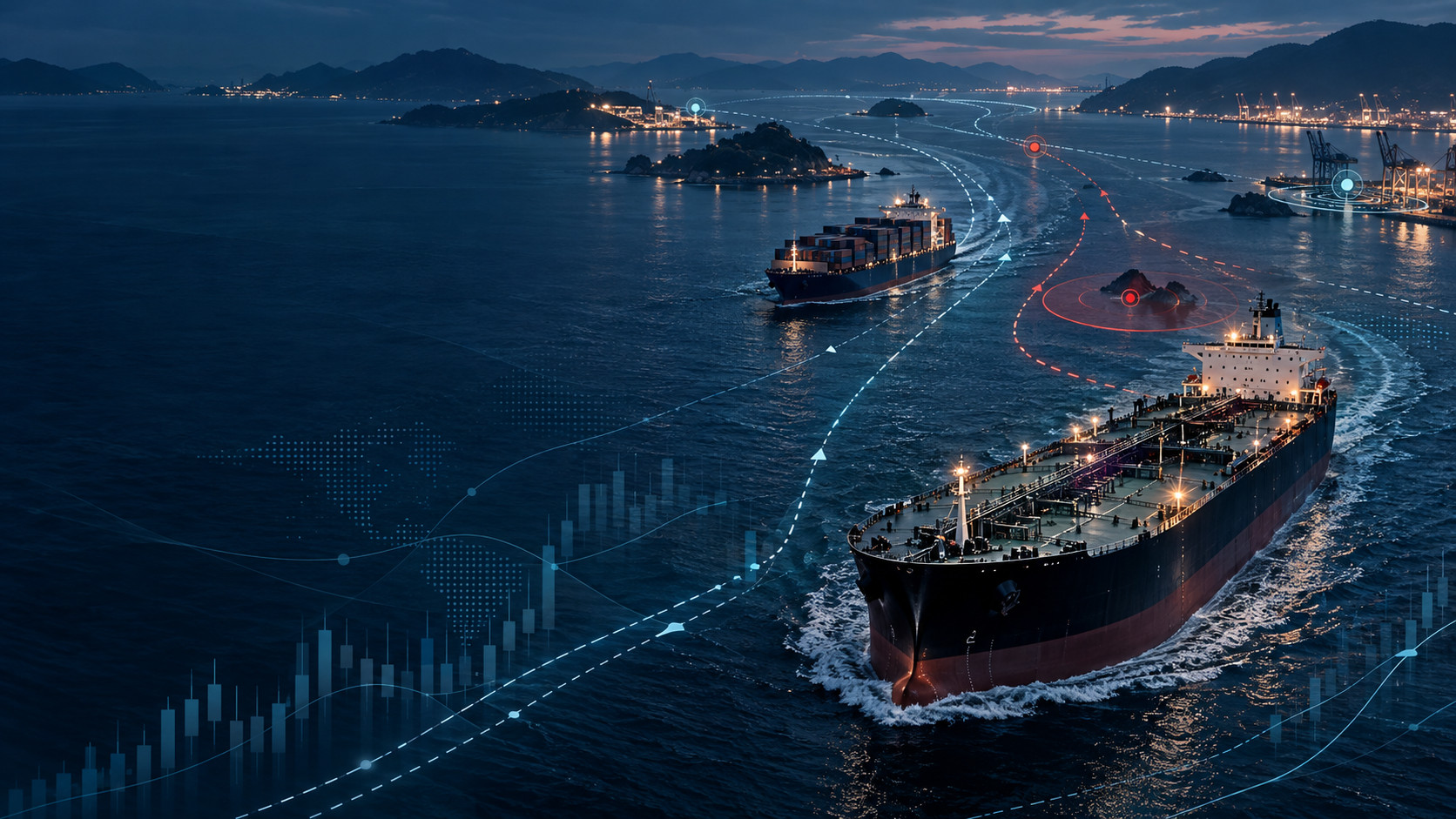
Shipping stocks have climbed roughly 68% in 2026, with crude-tanker equities leading the rally at over 120% year-to-date. For portfolio managers with exposure to maritime-linked assets, those numbers represent both opportunity and a problem: the same geopolitical disruption driving returns is also producing sanctions designations, route diversions, and insurance cost spikes that can change a position's risk profile overnight.
Dryad Global sits at the intersection of this problem. The organisations the platform supports, from marine insurers to commodities desks to fleet operators, all face the same question: how do you monitor what is actually happening to vessels, routes, and counterparties in near-real time, and how do you translate that into defensible decisions? For portfolio managers, the question has a specific edge. You are not routing a vessel or underwriting a hull. You are pricing exposure across dozens or hundreds of positions where maritime disruption is a variable you need to see before it appears in an earnings report.
What follows is a practical guide to how maritime risk intelligence platforms serve that function, what to look for when evaluating them, and where the discipline is heading.
What is maritime risk intelligence, and why does it matter for portfolio management?
Maritime risk intelligence is the structured collection, verification, and analysis of information about vessels, voyages, ports, threats, and counterparties. It connects incident data, sanctions screening, route-level assessment, and geopolitical context into an operational picture that supports decision-making.
For portfolio managers, maritime risk intelligence platforms provide visibility into a category of risk that traditional financial data terminals handle poorly. Freight rates, vessel earnings, and commodity prices are lagging indicators. They reflect disruption after it has occurred. A maritime risk intelligence platform shows what is developing: where incidents are escalating, which routes are being diverted, which vessels are accumulating sanctions indicators, and where supply chain chokepoints are forming.
The practical value is directional. A portfolio manager monitoring energy or shipping equities does not need the same granularity as an underwriter pricing a specific hull. But they do need to know when a corridor that carries a material share of global crude is becoming operationally constrained, or when sanctions enforcement is tightening around a fleet segment that touches their holdings. The Strait of Hormuz crisis in 2026 is a case in point: tanker tonne-miles increased as vessels rerouted, freight rates surged, and war-risk insurance premiums spiked, all before most portfolio-level risk models registered the shift.
Maritime risk intelligence closes that gap by providing structured, analyst-verified data on the events driving those downstream financial effects.
How do portfolio managers use vessel tracking to monitor exposure?
Vessel tracking through AIS (Automatic Identification System) data forms the foundation of maritime risk intelligence. AIS transmissions provide vessel identity, position, speed, heading, and destination. Combined with satellite and terrestrial receivers, this data creates a near-real-time picture of global vessel movements.
Portfolio managers use this data in several ways. Tracking vessel positions across a fleet or a set of counterparties reveals where assets are concentrated and whether they are transiting higher-risk regions. A portfolio with significant exposure to a tanker operator, for example, benefits from knowing how many of that operator's vessels are currently trading in areas with elevated war-risk premiums or active military operations.
The challenge is that raw AIS data is noisy. Vessels transmit inconsistently, GNSS interference can produce false positions, and some operators deliberately suppress or manipulate AIS signals to conceal activity. Dryad Global's Verihelm platform addresses this by combining AIS data with analyst verification and incident correlation, so that the position data feeding a risk picture has been tested against what is actually happening in the region. Vessel profiles in Verihelm bring together sanctions results, incident history, vessel characteristics, and watchlist monitoring around the specific vessel under review.
For portfolio managers, the practical application is exposure mapping. When a geopolitical event escalates, knowing which vessels in a portfolio's value chain are in or near the affected area allows faster assessment of potential earnings impact, insurance cost changes, and supply chain delays.
What sanctions risks should portfolio managers monitor in maritime exposure?
Sanctions enforcement in the maritime sector has intensified dramatically. In 2025, three major regulatory waves from OFAC, HM Treasury, and the EU designated over 700 vessels and expanded enforcement to target entire facilitation networks, including insurers, brokers, flag registries, and service providers.
For portfolio managers, sanctions risk in maritime exposure operates at multiple levels. Direct exposure exists when a portfolio holds equity or debt in a company whose vessels, counterparties, or trading routes intersect with sanctioned entities. Indirect exposure arises when a portfolio's supply chain depends on freight capacity or port access that sanctions enforcement could constrain.
The shadow fleet adds another dimension. Roughly 3,300 vessels were operating in shadow networks by late 2025, moving approximately 6 to 7% of global crude flows through structures designed to evade sanctions screening. These vessels employ systematic deceptive practices: AIS suppression, frequent flag changes, ship-to-ship transfers in permissive jurisdictions, and ownership layered through single-vessel shell companies. For portfolio managers, the relevant question is whether their holdings have counterparty exposure to these networks, even indirectly.
Traditional sanctions screening, based on name-matching against published lists, misses much of this activity. Names change. Ownership structures are designed to obscure beneficial control. A vessel screened clean at the time of a charter can become designated mid-voyage as enforcement actions catch up with behavioural patterns that intelligence platforms can detect earlier.
Verihelm screens vessels against current OFAC, EU, and UK sanctions lists and returns a match confidence score rather than a binary match-or-clear result. It records each completed check for due-diligence review and connects screening results with voyage and incident information, giving compliance and investment teams a fuller picture of the exposure around a specific vessel or counterparty.
How does supply chain disruption intelligence inform investment decisions?
Maritime disruption events rarely stay contained within shipping. A chokepoint closure, a sanctions escalation, or a sustained piracy campaign propagates through commodity prices, freight rates, insurance markets, and the earnings of companies across multiple sectors.
The Strait of Hormuz disruption in 2026 illustrates the mechanism. Once one of the busiest oil-shipping lanes, the corridor's operational constraints forced tankers onto longer routes, increased tonne-miles across the global fleet, pushed freight rates to multi-year peaks, and created war-risk insurance costs that repriced the economics of certain trade flows entirely. Shipping stocks surged, but so did costs for energy importers, refiners, and manufacturers dependent on timely crude delivery.
A maritime risk intelligence platform provides the early indicators. Incident frequency, threat-actor capability assessments, route diversions, and port congestion data all appear in the intelligence picture before they translate into the financial data a portfolio manager typically monitors. Dryad Global's Verihelm platform assesses voyage risk leg by leg, identifying where the nature or level of exposure changes and explaining what is driving it. Regional assessments carry threat levels, the reasoning behind them, and reassessment triggers that signal when conditions may be shifting.
For portfolio managers, this translates into earlier decision-making. Rather than waiting for a quarterly earnings revision to confirm that a shipping company's costs increased or a commodity producer's delivery schedule slipped, the intelligence provides the operational signal that the revision is likely. That lead time is the practical value.
What should portfolio managers look for when evaluating maritime risk intelligence platforms?
Not all maritime risk intelligence platforms serve the same function. Some focus narrowly on AIS tracking. Others provide sanctions screening as an isolated compliance tool. A platform suited to portfolio-level risk monitoring needs several capabilities working together.
Source provenance matters. Every material assessment should allow the user to understand where its supporting information originated, when it was collected, and how conflicting sources were handled. A platform that presents conclusions without showing the underlying evidence may add data without adding confidence. Dryad Global's approach to source-traced intelligence means that published assessments carry their source history and approval status.
Analyst verification distinguishes intelligence from automated data feeds. Automation is effective at collecting, matching, and organising large volumes of maritime information. Human analysis remains important when information is incomplete, contradictory, or rapidly changing. Verihelm's intelligence products pass through internal review, and the platform makes the review status visible to the user. The distinction between automated collection and analyst-reviewed assessment should be clear, not used as a vague quality claim.
Explainable methodology is a requirement, not a preference. Two platforms can assign different risk levels to the same voyage because they use different perils, data windows, geographic boundaries, or weighting methods. A useful result states its basis, confidence, and limitations. Portfolio managers should ask: which perils are included, how are they weighted, what data window is used, and how is uncertainty handled?
Integration capability determines whether the intelligence reaches the point of decision. A platform that cannot export results, provide API access, or feed into existing risk management workflows will have limited practical value for a portfolio team managing positions across multiple asset classes.
Coverage transparency is the final criterion. The provider should be able to explain which regions, ports, and threat categories are covered in depth, where coverage is thinner, and how frequently each source is updated. A blank field should never be interpreted as no risk, and an old assessment should never be treated as current.
How is the maritime risk intelligence landscape evolving for financial users?
The shift from reactive to predictive maritime compliance is reshaping how financial organisations interact with maritime risk data. In 2025, sanctions designations increasingly followed behavioural trails that analytics could detect before regulators acted. Vessels that were eventually sanctioned often displayed false AIS positions, frequent reflagging, irregular ship-to-ship activity, and opaque ownership structures weeks or months before enforcement.
This creates an opportunity for portfolio managers who integrate maritime intelligence into their risk frameworks. The ability to see sanctions indicators developing, rather than reacting to designations after they appear on published lists, provides lead time to assess exposure and adjust positions.
Three structural developments are accelerating this shift. First, regulators are pursuing network-level enforcement, targeting not just individual vessels but the brokers, insurers, managers, and intermediaries that enable sanctioned trade. For portfolio managers, this means that sanctions risk can propagate through service relationships, not just vessel ownership. Second, continuous screening is replacing point-in-time checks. Organisations that screened vessels only at the time of a charter are adopting event-driven monitoring that triggers alerts when sanctions lists change or vessel behaviour shifts. Third, transparency infrastructure is becoming standard. Insurers and classification societies are reducing exposure to high-risk tonnage, which is forcing the broader market to adopt stronger verification tools, compliance dashboards, and documented screening protocols.
Dryad Global's Verihelm platform is built around these principles. It provides continuous or event-driven re-screening throughout the life of an exposure, flags shadow-fleet indicators against vessels and counterparties, and maps GNSS interference, AIS anomalies, and emerging incident patterns to vessel routes. The platform connects intelligence to operational consequences across voyage planning, navigation resilience, crew safety, and insurance exposure.
For portfolio managers, the direction is clear. Maritime risk is becoming a data-rich, intelligence-led discipline. The organisations that integrate verified maritime intelligence into their investment processes will see disruption, sanctions shifts, and supply chain constraints earlier than those relying on traditional financial data alone.
The gap between what is happening at sea and what appears in a portfolio risk model is closing. The question is whether your risk framework is closing with it.