


Cross-Strait relations in the Lai era
On May 20, Lai Ching-te was inaugurated as Taiwan's new president, prompting significant military...
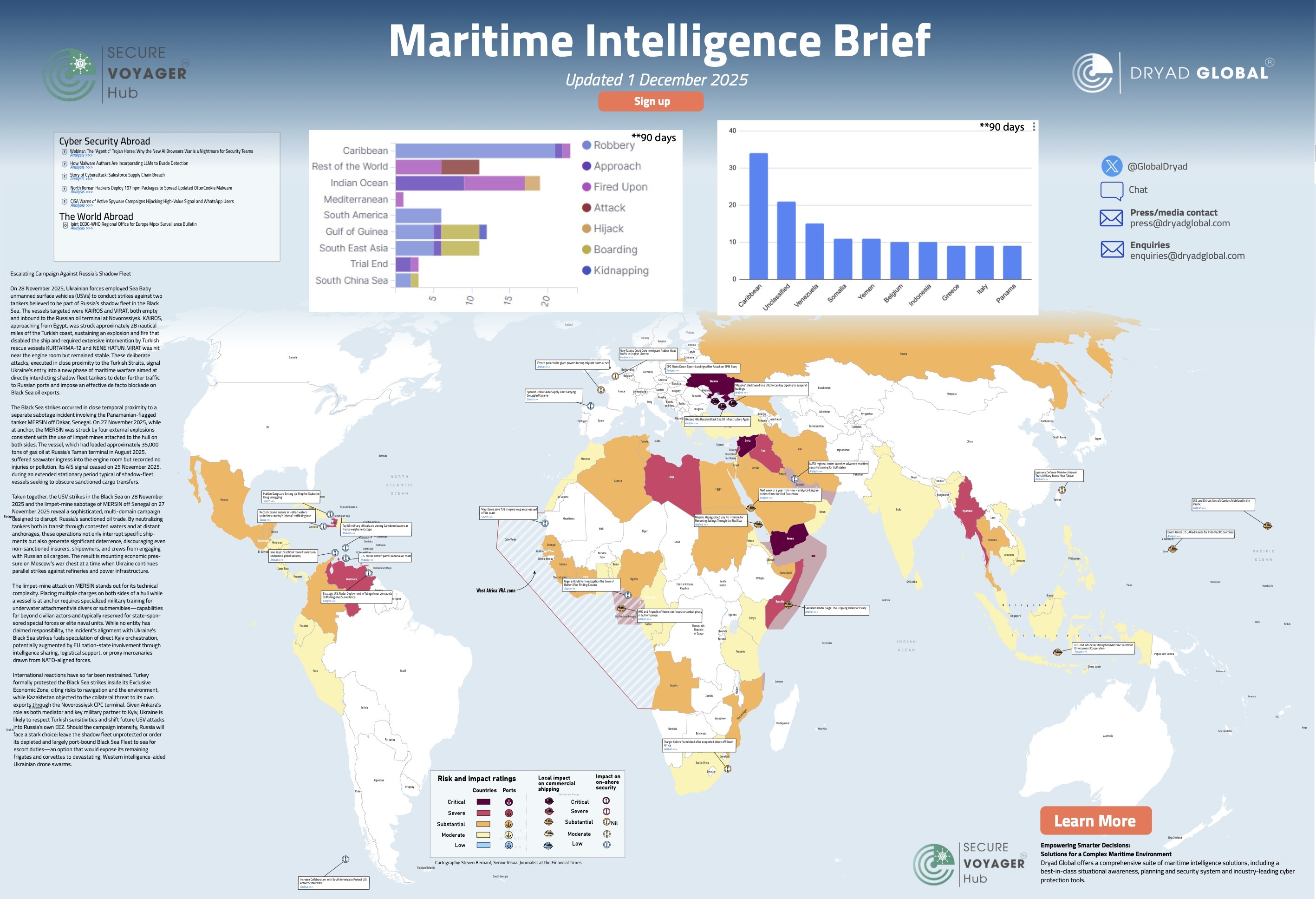
This week’s Maritime Intelligence Brief – 1 December 2025 highlights how quickly the risk picture is shifting across both traditional and emerging theatres. From Black Sea sabotage to cyber-enabled threats and persistent piracy, the signal for shipowners, charterers, and insurers is clear: operational decisions now depend on a joined-up view of physical, geopolitical, and cyber risk.
Below is a high-level snapshot of what Dryad Global analysts are tracking. The full brief including incident-level analysis, risk ratings, and route-specific guidance is available exclusively via Secure Voyager Hub.
The standout development this week is an escalating campaign against Russia’s “shadow fleet”.
Ukrainian Sea Baby unmanned surface vehicles (USVs) struck two tankers, KAIROS and VIRAT, inbound to Novorossiysk, in close proximity to the Turkish Straits. One vessel suffered fire and loss of power; the other remained afloat after damage near the engine room. In parallel, the Panamanian-flagged tanker MERSIN – previously loaded with Russian product – was hit by multiple limpet-mine explosions off Dakar, Senegal, while at anchor.
Taken together, these incidents point to a multi-domain effort to disrupt sanctioned Russian oil exports, targeting tankers both in transit and at distant anchorages. For commercial operators, the key questions now are:
How far and how fast this campaign will expand geographically
What increased exposure looks like for vessels carrying Russian-origin cargo or engaging with opaque counterparties
Whether Russian naval assets will be forced out to escort duties, changing the risk equation again
Our subscribers receive detailed profiling of the vessels involved, assessed responsibilities, and likely implications for Black Sea, Mediterranean and West African trades.
The world map and incident dashboards in this week’s brief continue to show a complex mix of piracy, robbery, approaches, and boarding events in key shipping lanes, particularly across the Gulf of Guinea, Indian Ocean, and Southeast Asia. While headline incident numbers fluctuate, the risk to seafarers remains persistent, with criminals and armed groups adapting routes and tactics in response to naval patrols and industry counter-measures.
Alongside piracy, we’re tracking:
State responses to irregular migration at sea – including new French authorities to stop migrant boats, and evolving approaches to rubber-boat traffic in the English Channel.
Caribbean and Latin American security dynamics – from Haitian gangs turning increasingly to seaborne drug smuggling, to record cocaine seizures and heightened U.S. aerial and maritime surveillance off Venezuela and in surrounding waters.
Major-power signalling at sea – with U.S. and Chinese carrier deployments, Indo-Pacific naval exercises, and Japanese defence activities near Taiwan shaping the wider strategic backdrop for commercial shipping routes.
Each theme carries different implications for routing, port calls, insurance, and crew security – issues we explore in detail inside Secure Voyager Hub.

Beyond the physical domain, this week’s cyber section focuses on how malware authors and state-linked actors are exploiting new technologies and platforms:
The rise of “agentic” AI browsers and why they create fresh attack surfaces for corporate networks
The use of large language models (LLMs) in malware to better evade traditional detection tools
High-impact supply-chain compromises, such as large SaaS and CRM platforms used across shipping, logistics, and trade finance
Targeted spyware campaigns against high-value communications apps used by senior executives and government officials
For vessel operators, charterers, and port stakeholders, the message is that voyage risk is now inseparable from cyber risk. The same platforms used to plan and execute operations can be weaponised against them; understanding this overlap is essential to protecting both people and cargo.
The World Abroad section broadens the lens further, capturing developments that may not immediately appear maritime, but which shape the operating environment:
Public-health alerts such as the latest joint ECDC–WHO mpox surveillance bulletin
Evolving nuclear, missile, and sanctions dynamics involving Russia, China, Iran, North Korea and others
NATO regional initiatives, including advanced maritime security training for Gulf states and closer cooperation on sanctions enforcement
These signals influence everything from flag-state posture and port-state control to insurance appetite and regulatory pressure on maritime actors.
This week’s brief underscores a simple reality:
A tanker sabotaged off West Africa can be linked to cargo loaded months earlier in the Black Sea.
A cyber campaign against messaging apps can compromise voyage planning and charter negotiations.
Piracy, migration, organised crime, and great-power competition increasingly overlap in the same sea lanes.
Static risk maps or occasional advisories are no longer enough. Shipowners, operators, P&I clubs and insurers need continuous, contextualised intelligence that ties individual incidents back to the wider strategic picture – and turns that into clear guidance for real-world decision-making.
The public overview you’ve just read is only the surface. Inside Secure Voyager Hub, subscribers gain access to:
The full weekly Maritime Intelligence Brief
Interactive global risk maps and incident dashboards
Region- and route-specific assessments
Cyber and physical threat analysis in a single environment
Practical recommendations to support planning, routing, and crew security
Explore the introductory offer and start your trial here:
https://www.dryadglobal.com/secure-voyager-hub-intro-offer
Stay ahead of the risk – and give your teams the intelligence they need to make smarter, safer decisions at sea.


The United States on Tuesday sanctioned a network of oil trading firms, individuals and vessels..
In the face of international sanctions, the Iranian regime has persistently engaged in oil..
Iran's oil production has surged back to near pre-sanctions levels, despite years of U.S. sanctions..
Press/media contact
Email Us
General Enquiries
Contact Us Here

© 2024 Dryad Global. All Rights Reserved