
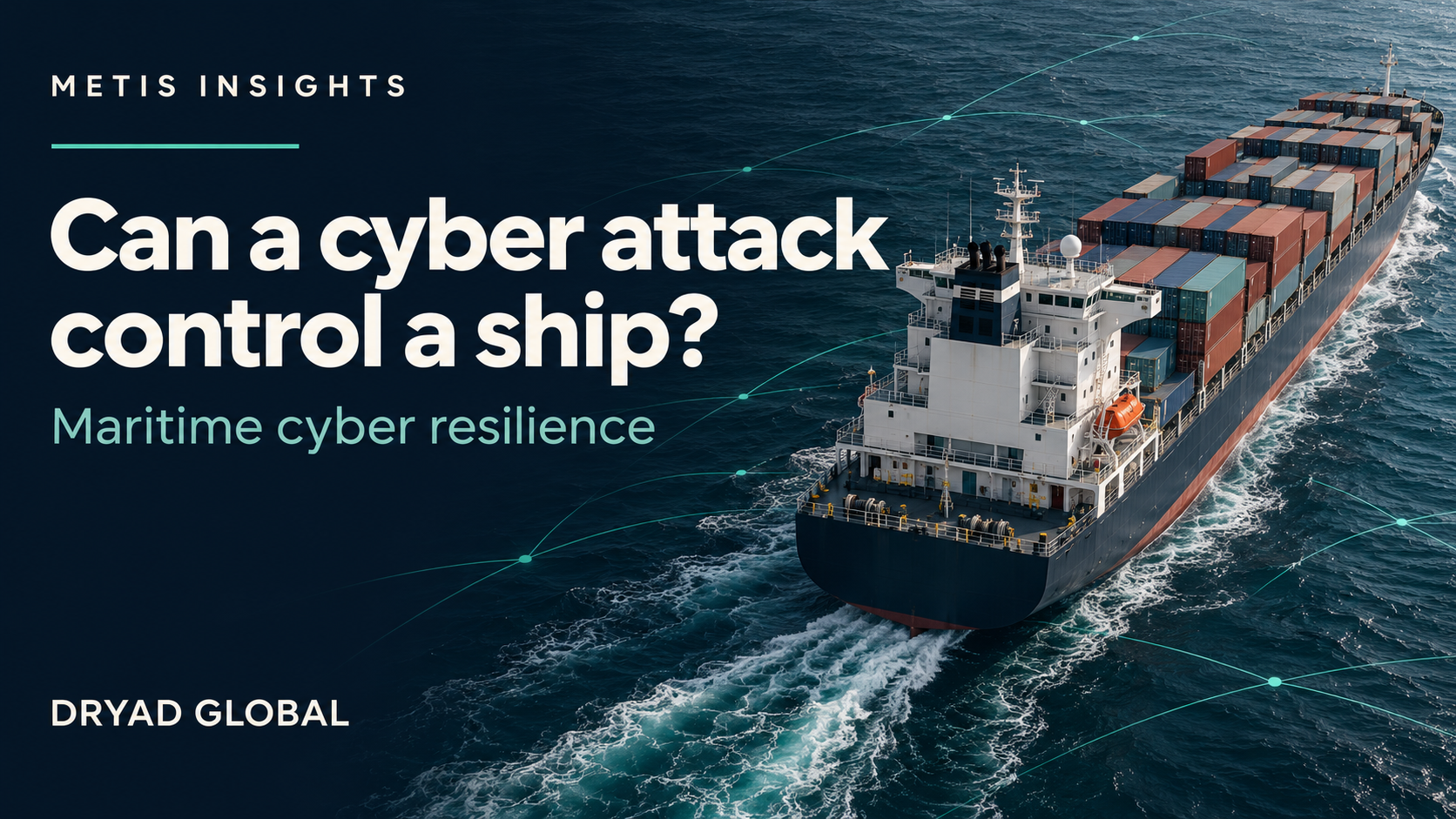
If a critical system became untrustworthy during a port approach, could your crew recognise the problem, maintain safe control and coordinate a response with shore?
For ship operators, that question brings cyber security into sharp focus. The consequences can extend from compromised information to delayed port calls, interrupted cargo operations and uncertainty about the systems crews depend on.
Dryad Global’s refreshed Cyber METIS: Can a Cyber Attack Control a Ship? explores these operational challenges. Updated for November 2026, the report combines the original expert discussion with current maritime guidance, practical readiness questions and a checklist for ship and shore teams.
It is designed to help shipping companies identify where they need greater visibility, stronger safeguards or specialist support.
From digital access to operational disruption
A cyber incident does not need to take control of a vessel to disrupt a shipping company.
A compromised email account can undermine confidence in instructions. An infected maintenance laptop can introduce an unexpected exposure. Uncontrolled supplier access can leave an operator uncertain about who can reach onboard systems.
The challenge is understanding how these entry points connect to the services and equipment that keep vessels operating.
The refreshed Cyber METIS examines those connections across information technology, operational technology and ship-shore communications. It also considers the realities of maritime operations: legacy equipment, limited connectivity, changing crews and multiple service providers.
What the ship-control simulation reveals
One of the report’s central examples is a Cyber-SHIP demonstration involving a container vessel approaching a confined waterway near New York.
In the simulated scenario, malicious behaviour affects propulsion and steering while normal bridge commands fail to produce the intended response.
This is a demonstration, rather than a reported vessel hijacking. Its value lies in the questions it raises for operators:
- Could bridge and engine teams recognise conflicting indications?
- Are approved fallback arrangements understood and practised?
- Can the crew reach the right shore personnel when connectivity is limited?
- Are technical suppliers included in response planning?
- What evidence would support a safe return to normal operations?
These questions help turn a dramatic scenario into a useful preparedness discussion.
Sister ships can develop different cyber exposures
A shared design does not guarantee that vessels remain configured in the same way throughout their operating lives.
Different patch schedules, temporary devices, charterer equipment and supplier interventions can change networks over time. An inventory or network diagram that was accurate at delivery may no longer reflect the vessel in service.
For fleet managers, this makes visibility essential. Knowing what is connected, who owns it and which systems support critical operations provides a foundation for prioritising protection.
The report explores how operators can approach that task while accounting for equipment compatibility, maintenance requirements and operational constraints.
Protection must work beyond the alert
Early detection matters. So does the ability to act.
At sea, a response may depend on limited bandwidth, an unavailable supplier or a crew already managing a demanding operation. Security tools therefore need to be considered alongside clear responsibilities, approved procedures and recovery arrangements.
The refreshed Cyber METIS examines the role of AI-assisted protection while keeping the focus on practical questions: what continues working offline, who receives an alert, and how is the next action agreed?
It also updates the regulatory context and explores navigation resilience, reporting and the relationship between regional maritime risk and onboard preparedness.
Start with your fleet’s most important unanswered question
You do not need to resolve every cyber security challenge before starting a useful conversation.
Begin with one priority: a critical system, supplier access, crew readiness or confidence in recovery.
Dryad Global’s refreshed Cyber METIS provides a framework for that discussion, helping operators connect technical concerns with operational consequences.
Request your copy and speak to Dryad Global about your fleet’s cyber security needs.
Contact Dryad Global at sales@dryadglobal.com
You can also request a Verihelm demo to explore how Dryad Global’s maritime risk intelligence supports decisions across your operating routes, port calls and wider exposures.