
Reviewed: 22 August 2026
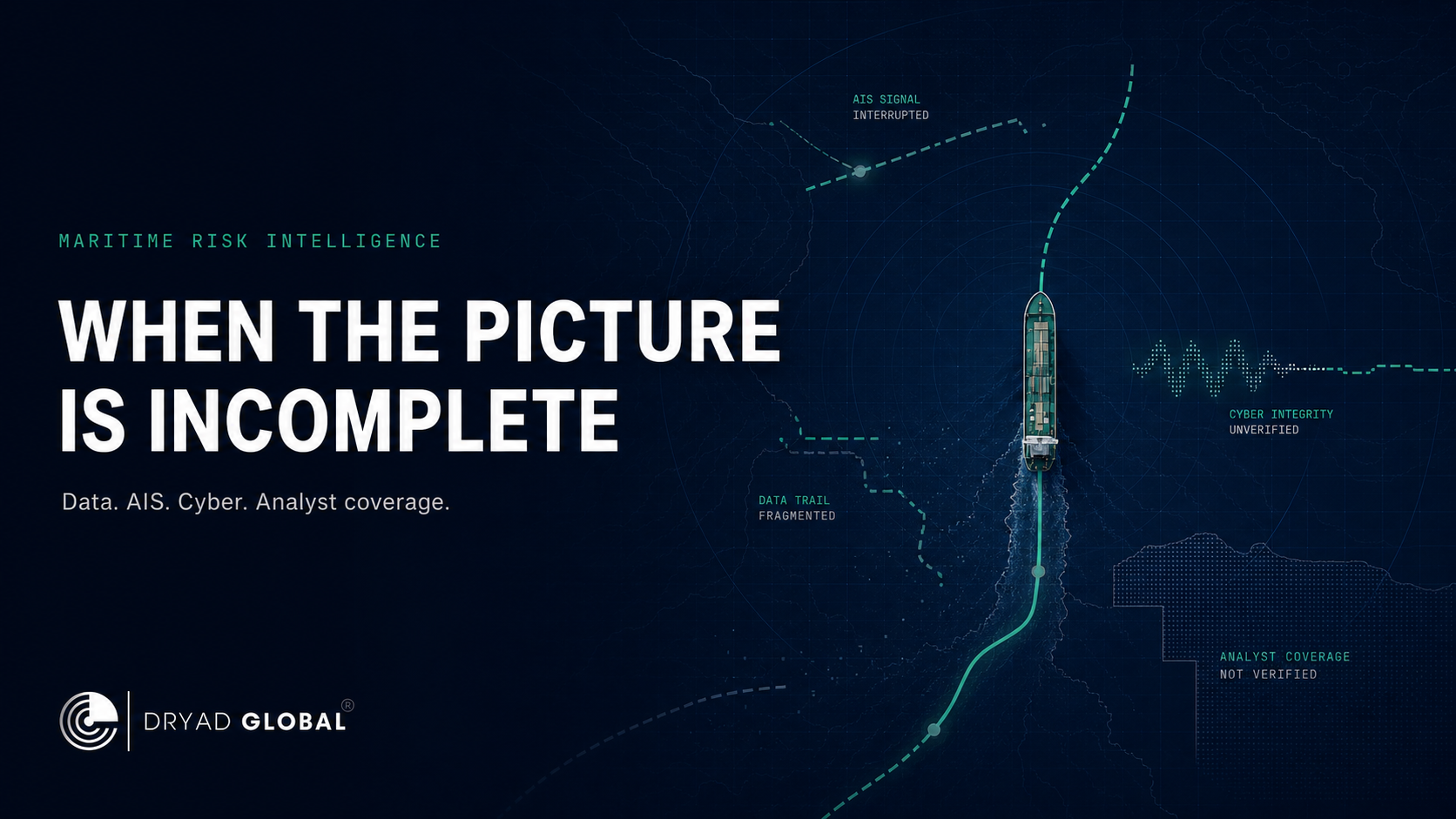
A risk platform can look complete even when the picture behind it is not. Vessel movements go unreported, ownership records change, threat assessments age and different sources contradict one another. When those gaps are absorbed into an automated result without explanation, the system can appear more certain than the evidence allows.
Not every gap conceals wrongdoing. The danger is that unexplained uncertainty may shape a route, port call, transaction or insurance decision without anyone recognising that it is there.
Not Every Gap Is Suspicious
Maritime risk assessments draw on information collected for different purposes, by different organisations and at different speeds. AIS illustrates the problem: it provides valuable information about a vessel's identity, position, course and speed, but it was never intended to be a complete global record of vessel activity.
Carriage requirements do not cover every vessel, reception varies and transmitted information can be incomplete or incorrect. In limited circumstances, a Master may also decide that continued transmission would endanger the safety or security of the ship. AIS can also be disabled or manipulated to conceal activity. International Maritime Organization
The same visible gap can therefore have several explanations. Treating it as proof of wrongdoing creates false positives, while ignoring it can leave relevant activity unexplored. A credible assessment considers what happened before the gap, where it occurred, how long it lasted, what the vessel did next and whether other information supports an explanation.
Where the Picture Breaks Down
Incident reports, coastal warnings, sanctions lists, company records, port information and commercial vessel data do not update together. An incident may be reported before its location or severity is clear, while a corporate change may appear in one record long before it reaches another.
Differences in names and terminology create further uncertainty. The same vessel, company or place may be recorded in several ways across jurisdictions and reporting systems. If a platform merges those records without recognising conflicts or gaps, separate claims can appear to be one settled fact. Adding more information does not solve that problem by itself; the reporting has to be compared, tested and placed in context.
Identity, Movement and Ownership Remain Difficult to Join
A vessel can change its name, flag, operator or registered owner. Company structures may place several entities between an asset and the party that ultimately controls it, while names can be transliterated or recorded differently across jurisdictions.
Screening a single vessel name is therefore not the same as understanding the vessel or transaction. The assessment may need to consider persistent identifiers, aliases, ownership and management records, previous flags, trading patterns, port calls, counterparties and relevant incident history. Even then, a no-match result describes what was found against the information and lists checked at that time; it does not establish that no wider exposure exists.
Technology Can Produce Confident-Looking Errors
AIS positions and other maritime systems depend on equipment, communications and positioning signals that can fail or be interfered with. GNSS jamming and spoofing can make apparently valid location data unreliable, while cyber incidents can affect the availability or integrity of both shipboard and shore-based information.
The IMO treats corrupted, lost or compromised systems and data as potential causes of operational, safety and security failure. IMO maritime cyber-risk guidance
Automation can identify inconsistencies across more information than an analyst could monitor manually, but it cannot assume that every machine-readable result is true. Where systems disagree, the conflict needs to remain visible until the available evidence supports a conclusion.
The Assessment Can Age Before the Decision Is Made
A voyage assessment reflects conditions at a particular time. Conflict may escalate, reporting requirements may change, a port can impose new restrictions and a sanctions designation or ownership change can alter the exposure around a vessel or counterparty.
An assessment that was reasonable when produced may therefore no longer support the same decision later. Its validity period and reasons for reconsideration need to be clear, particularly where a route changes or an incident affects the planned transit.
What Can a Gap Change?
The same missing or misunderstood information affects organisations differently. A ship operator may commit a vessel to a route without seeing that the threat has changed, while a charterer or trader may discover too late that a nominated vessel or counterparty requires closer examination.
For an insurer, the gap may distort the view of the vessel, voyage or operating area. A financier may struggle to establish the parties and activity behind a transaction, while a compliance team may escalate legitimate activity unnecessarily or overlook a relationship that warranted further work. The cost can appear before any incident occurs through delayed decisions, avoidable diversions, unsuitable terms, repeated due diligence or an inability to explain why an earlier decision was made.
What Does a Credible Assessment Do Differently?
No platform can remove every unknown, but it can make uncertainty harder to overlook. Relevant information should be brought together without pretending that every source carries the same weight, and vessel identity, movement, ownership, incident and threat information should be tested against one another.
Experienced analysts remain important because the evidence does not always speak for itself. They can recognise when two reports describe the same event, when a local development changes the meaning of a wider pattern or when an apparently suspicious gap has a credible operational explanation. Their role is not to make uncertainty disappear, but to judge what the available information supports, what remains unresolved and why that matters to the customer's decision.
From More Information to a Clearer Decision
Maritime risk assessment is not a search for perfect visibility. The practical goal is to identify the information that could change a decision, test it from more than one angle and make the remaining uncertainty clear.
Verihelm brings incidents, assessments, actors and threat areas into one environment. Information is blended across multiple sources, with Dryad Global's intelligence team applying judgement where context, ambiguity or possible consequence requires it. This helps customers move beyond an isolated alert or headline and understand the wider risk while they still have choices.
Frequently Asked Questions
Why can a maritime risk assessment contain gaps?
Vessel movements, ownership records, incident reporting and threat conditions come from different sources that update at different speeds. A sound assessment identifies those gaps and explains how they affect confidence in the result.
Does an AIS gap mean a vessel is acting suspiciously?
No. Coverage limitations, equipment faults and legitimate security decisions can all interrupt AIS reporting. The gap needs to be considered against the vessel's location, route, identity, other activity and any available explanation.
What should a maritime risk platform do when information is incomplete?
It should identify the uncertainty, test the available information against other sources and involve experienced analysts where context or possible consequence requires judgement.
This article provides general information and analysis. It is not legal advice or a vessel-specific risk assessment.